

Fathym Calls for Owned AI Context as AI Adoption Moves Across Tools and Teams
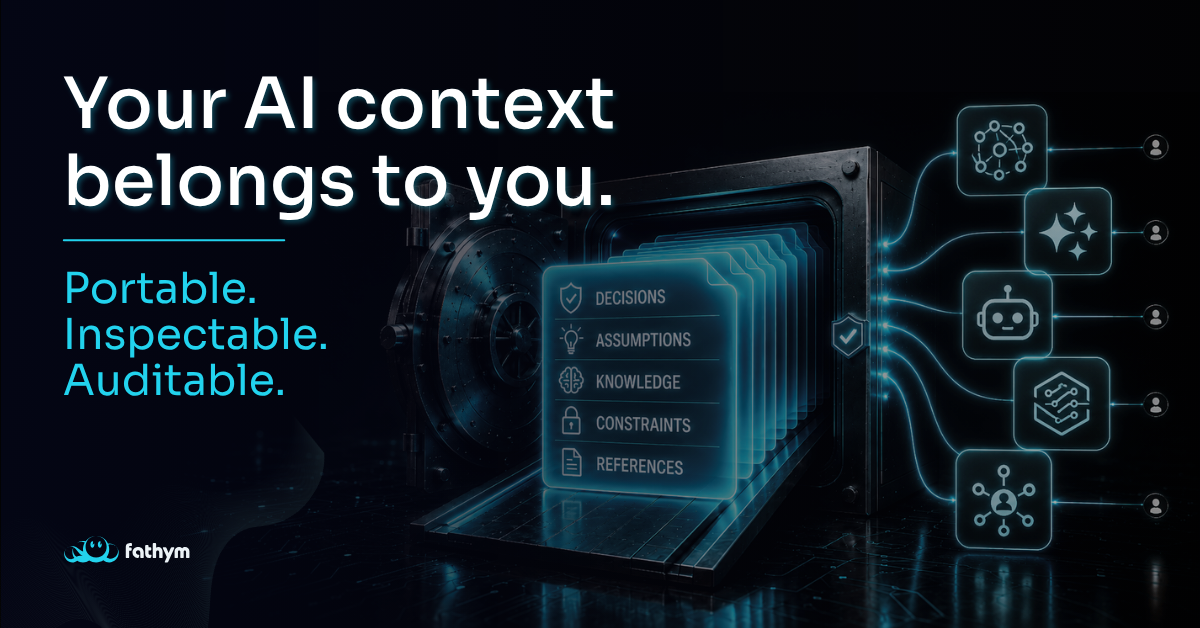
Fathym says AI-assisted work creates decisions, assumptions, and knowledge that should remain inspectable, auditable, portable, and owned across tools and teams.
Fathym says teams need portable, inspectable AI context as work spreads across coding, research, planning, automation, and operations.
AI use is spreading faster than most organizations can turn it into trusted business output. McKinsey's 2025 global AI survey found that 88% of respondents report regular AI use in at least one business function, but only about one-third say their companies have begun scaling AI programs. Microsoft's 2026 Work Trend Index reinforces the same point: AI value depends on organizational systems, not only individual willingness to use the tools.
Many companies encouraged employees to use AI before those support systems existed. Some expected AI to reduce staffing needs or offset human labor, but the knowledge that makes AI useful still lives inside individual people. Years of customer nuance, engineering constraints, and relationship-saving judgment may never exist in a company database. When that human knowledge enters an AI session without a durable record, the organization has converted intelligence into output without keeping the intelligence itself.
The concern extends beyond inefficiency. It is the difference between keeping a finished answer and keeping the thinking that made the answer valuable and repeatable. When employees leave, tools change, or teams need to audit a decision, the output alone is not enough. The intellectual path is what lets a team trust, repeat, and defend the result.
Paper trails and digital records once helped teams look back and understand how decisions were made. AI conversations can replace that thinking process without leaving the same durable record. A closed chat window can erase the equivalent of a notebook, while a long transcript can bury the reasoning trail inside more text than teams can realistically use.
Leonardo da Vinci's notebooks are valuable not simply because they contain sketches and inventions, but because they let people see a mind at work. Modern organizations create their own working notebooks every day through AI conversations. If those notebooks are scattered across vendor systems, private accounts, and disposable sessions, organizations are not just misplacing files. They are losing part of the human intelligence that made the work possible.
Fathym's position is direct: owned AI context is organizational intellectual property. Companies and individuals need a way to keep the reasoning and lessons that make AI-assisted output useful. That context has to remain under the creator's control, with enough structure to edit, audit, and reuse it, or the organization keeps losing the intelligence its people create.
Research points to the same operating gap. MIT NANDA's 2025 "GenAI Divide" report found that many generative AI efforts stall because tools do not retain feedback, adapt to context, or fit daily workflows. Harvard Business Review also reported on "AI-generated workslop," where low-effort AI output shifts costly effort downstream to colleagues who must interpret, correct, or redo it. These findings do not argue against AI. They show why AI access alone is not enough.
"AI is becoming the place where people think through their decisions," said Matt Smith, CEO of Fathym. "If that thinking disappears into tools you do not control, you are losing intellectual property, not chat history. Fathym is built around a simple idea: the intelligence you bring into AI sessions belongs to you."
The problem becomes more urgent as teams spread tasks across multiple AI tools. Engineering, research, planning, and automation may each happen in a different system, but none of those systems can protect the full record unless the organization keeps its own context layer outside of the tools themselves. Without that layer, people become the manual bridge between systems, reconstructing the same knowledge every time a project moves.
Fathym created fAI to help technical users keep control of their AI context. Rather than functioning as another AI agent, fAI applies an AI context layer around the development process, helping the right personal preferences, tool context, project decisions, patterns, instructions, and session learnings surface at the right moment. With the latest release, fAI extends from preserving context toward compounding project knowledge, helping each session build on prior context instead of requiring the same foundation to be reconstructed repeatedly.
Fathym is extending the same principle toward team and enterprise workflows, where AI context has to be governed before AI can become a trusted part of daily operations. As organizations move beyond experimentation, the question is no longer only which model or assistant to use. It is whether they can keep control of the intelligence their people are putting into AI.
For more information about Fathym and fAI, contact Shannon Kendall through the release contact information or visit Fathym's website.
Shannon Kendall
Fathym Inc.
shannon.kendall@fathym.com
Visit us on social media:
LinkedIn
X
Bluesky
Instagram
YouTube
Legal Disclaimer:
EIN Presswire provides this news content "as is" without warranty of any kind. We do not accept any responsibility or liability for the accuracy, content, images, videos, licenses, completeness, legality, or reliability of the information contained in this article. If you have any complaints or copyright issues related to this article, kindly contact the author above.
