

Millet Market to Reach USD 18.72 Billion by 2032 at 4.89% CAGR: Rising Demand for Nutritious Grains
Millet Market graph
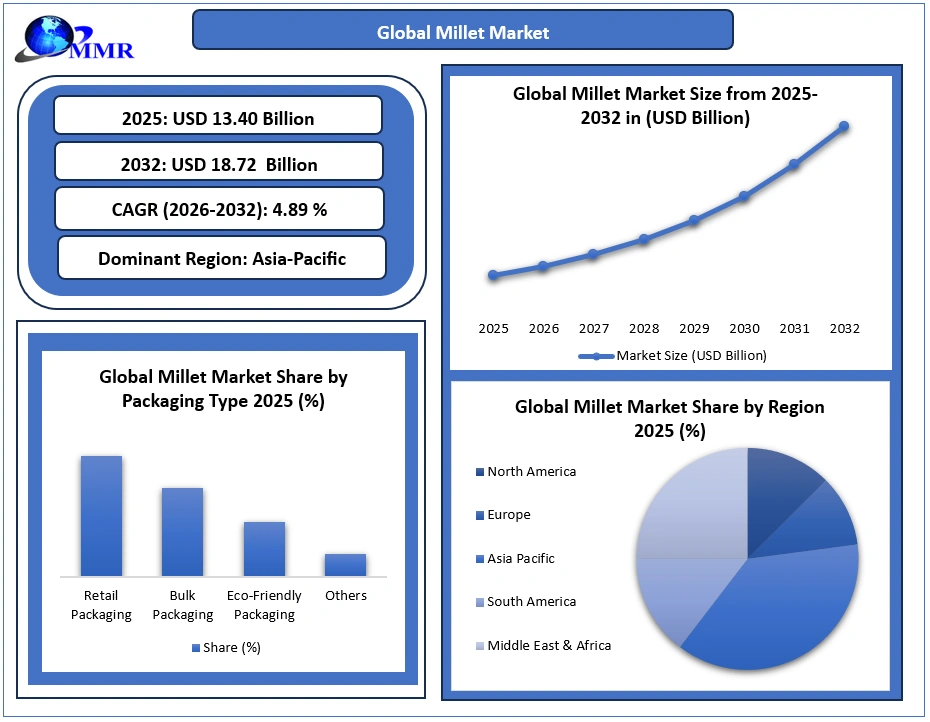
The global millet market was valued at USD 13.40 billion in 2025 and is projected to reach USD 18.72 billion by 2032, growing at a CAGR of 4.89%.
Maximize Market Research uncovers how the global millet surge is fundamentally driven by the urgent financialization of agricultural carbon credits.”
ROCKVILLE , MD, UNITED STATES, March 9, 2026 /EINPresswire.com/ -- The Global Millet Market is undergoing a structural revaluation, evolving from a traditional staple into a strategic asset for climate-risk mitigation. Maximize Market Research identifies that the industry, valued at USD 13.40 Billion in 2025, is now a focal point for institutional investors seeking ESG-compliant agricultural portfolios. With a projected CAGR of 4.89%, the market is on track to hit USD 18.72 Billion by 2032, driven by a 2026 surge in "Smart-Sourcing" mandates.— Maximize Market Research
Get Full PDF Sample Copy of Report: (Including Full TOC, List of Tables & Figures, Chart) @ https://www.maximizemarketresearch.com/request-sample/105674/
This growth is anchored in the grain’s ability to function within the newly launched Rs 20,000 Crore Carbon Credit Programme. In March 2026, millets are being leveraged not just for their 4.89% yield resilience, but as a primary tool for soil organic carbon (SOC) restoration. As traditional water-intensive cereals face increasing climate volatility, millets offer a stable, low-input alternative that bridges the gap between global food security and the burgeoning voluntary carbon market.
Precision Processing & Lipase Activity Hindrance
The commercial scalability of the millet sector is being redefined by breakthroughs in Precision Processing, specifically targeting the inactivation of Triacylglycerol Lipase (TAG-lipase). A primary anchor for this shift is the ANVESH 2026 International Conference held at NIFTEM, where global delegates recently highlighted Non-Thermal Cold Plasma (CP) as the definitive solution for hydrolytic rancidity. This technology is critical because it effectively "locks" the grain’s lipid profile without degrading temperature-sensitive bioactive compounds.
By achieving a 90% reduction in lipase activity, manufacturers are now extending the shelf life of pearl and finger millet flour from seven days to over six months. These precision treatments, validated through 2026 pilot studies in Odisha’s Millet Mission clusters, ensure that high-lipid varieties remain stable for global export. This shift from traditional roasting to targeted Enzyme Hindrance is transforming millets into a viable, long-term ingredient for the global Ready-to-Cook (RTC) and industrial bakery segments.
Economic Driver: The North American Regenerative Surge
The economic trajectory of the North American millet sector is being rewritten by the February 2026 U.S. Treasury announcement regarding Section 45Z Clean Fuel Production credits. Maximize Market Research highlights that millets, classified as "low-intensity" climate crops, are becoming a high-yield financial asset for farmers seeking to lower their Carbon Intensity (CI) scores. Because millets require 70% less water than traditional cereals, they are now a primary candidate for Scope 3 emission reduction programs within the U.S. food supply chain.
A definitive real-world anchor is the Microsoft–Indigo AG 2026 agreement, which recently expanded its soil carbon credit registry to include drought-resilient millet clusters in Colorado and Nebraska. By utilizing digital MRV (Measurement, Reporting, and Verification) systems, North American growers are now receiving direct payments—averaging $20–$30 per acre—for verified carbon sequestration. This monetization model, coupled with the 4.89% CAGR, is de-risking the transition to regenerative agriculture and incentivizing a shift toward "climate-smart" grains across the Great Plains.
Supply Chain Resilience: The North American Sourcing Hubs
The North American millet sector has transitioned from import-dependency to a robust domestic sourcing model. Maximize Market Research identifies Colorado and Nebraska as the epicenter of this shift, where infrastructure investments are currently scaling to meet a 4.89% CAGR. A definitive real-world anchor is the Ardent Mills 2026 facility expansion in Commerce City, Colorado. This project is specifically designed to optimize the processing of ancient grains like Proso Millet, ensuring the purity and "5-log" microbial reduction required for large-scale food manufacturing.
Simultaneously, Bay State Milling’s Sterling, Colorado plant is leading the multi-stage cleaning and hulling revolution, sourcing directly from family farms in the High Plains. By localizing the value chain, these hubs are reducing logistical "food miles" and providing the supply security North American FMCG conglomerates demand. This regionalization is the primary hedge against global trade frictions, ensuring millets remain a stable, cost-effective ingredient for the domestic gluten-free and plant-based markets.
Segmentation Analysis: Global Consumption Trends & The High-Growth "Online" Pivot
The global millet landscape is defined by a transition toward high-value Value-Added Consumables. Pearl Millet currently dominates the market with a 40.5% revenue share, followed by Finger Millet (Ragi), which is growing at a 6.6% CAGR due to its role in the global Infant Food segment—a category that now commands a significant portion of the F&B application share. In Western markets, Proso and Foxtail varieties are seeing a surge, driven by their use in Ready-to-Eat (RTE) snacks, which are expanding at an annual rate of 18%–22%.
Cultivation trends reveal that while Conventional methods hold 73% of the market, the Organic segment is the fastest-growing niche as consumers prioritize residue-free products. This shift is mirrored in distribution; while Supermarkets and Hypermarkets anchor 55% of global sales, Online Retail is the fastest-growing channel. By leveraging Eco-Friendly, Retail-Ready Packaging, digital platforms are capturing the modern demographic, ensuring millets remain a centerpiece of the 2026 sustainable food transition.
Get Full PDF Sample Copy of Report: (Including Full TOC, List of Tables & Figures, Chart) @ https://www.maximizemarketresearch.com/request-sample/105674/
By Product Type
Finger Millet
Pearl Millet
Kodo Millet
Foxtail Millet
Proso Millet
Barnyard Millet
Little Millet
By Application
Bread goods,
Alcoholic and non-alcoholic beverages
Breakfast foods
Infant food
By Nature
Organic
Conventional
By Packaging Type
Retail Packaging
Bulk Packaging
Eco-Friendly
Others
By Distribution Channel
super and hypermarkets
grocers
online retailers
Others
The Sustainability Pivot: Scope 3 Compliance & Net-Zero Audits
The global millet transition is driven by the urgent need for Scope 3 decarbonization. As multinational food corporations prepare for the January 2027 CSRD reporting deadlines, millets have emerged as a primary compliance asset. Unlike water-intensive cereals, millets require 70%–80% less irrigation and have a significantly lower carbon footprint, making them ideal for reducing upstream value-chain emissions.
By integrating climate-resilient grains into their portfolios, Tier-1 processors are effectively de-risking their supply chains against the tightening SBTi (Science Based Targets initiative) standards. This shift from "voluntary ESG" to "mandatory audit readiness" ensures that millet-based supply chains are not only ecologically sustainable but are also legally resilient in a strictly regulated net-zero economy.
Global Millet Market, Key players
1) Archer Daniels Midland Company
2) Cargill
3) Bunge Limited
4) Nestlé S.A.
5) General Mills, Inc.
6) Olam International Limited
7) Louis Dreyfus Company
8) COFCO Group
9) Ardent Mills
10) Bayer CropScience AG
11) ITC Limited
12) Tata Consumer Products Limited
13) Sresta Natural Bioproducts Pvt. Ltd.
14) Wholsum Foods Pvt. Ltd.
15) Nature Mills Private Limited
16) Jiwa Healthy by Nature
17) Bliss Tree
18) Bonn Group of Industries
19) Molino Agostini
20) NH Foods Ltd.
Get access to the full description of the report @ https://www.maximizemarketresearch.com/market-report/global-millet-market/105674/
FAQ’s
How do millets generate revenue beyond retail sales?
Ans: In 2026, millets serve as Carbon Sequestration Assets. Farmers earn secondary income through verified offsets, averaging $20–$30 per acre via digital MRV platforms like Indigo AG.
What is the "Scope 3" advantage of millet sourcing?
Ans: Millets require 70% less irrigation than rice, allowing FMCG firms to slash upstream water-intensity scores and meet January 2027 CSRD compliance deadlines.
Why is "Lipase Inactivation" critical for 2026 exports?
Ans: Precision Cold Plasma treatments reduce lipase activity by 90%, extending flour shelf-life to six months and enabling stable, transcontinental supply chains.
4. What defines a "Climate-Smart" millet label in 2026?
Ans: It identifies grains produced under verified low-input protocols, qualifying for U.S. USDA Climate-Smart tax incentives and premium pricing in regenerative retail tiers.
Related Reports
Millet Based Packaged Food Market: https://www.maximizemarketresearch.com/market-report/millet-based-packaged-food-market/193879/
Millet Flour Market: https://www.maximizemarketresearch.com/market-report/millet-flour-market/187340/
Top Reports:
India Footwear Market https://www.maximizemarketresearch.com/market-report/india-footwear-market/20980/
Luxury Fashion Market https://www.maximizemarketresearch.com/market-report/luxury-fashion-market/126250/
K Pop Events Market https://www.maximizemarketresearch.com/market-report/k-pop-events-market/186929/
India Elevator Market https://www.maximizemarketresearch.com/market-report/india-elevator-market/110912/
Wool Market https://www.maximizemarketresearch.com/market-report/wool-market/210009/
About Maximize Market Research
Maximize Market Research is a leading global market research and business consulting firm. Our revenue-impact and growth-driven initiatives empower Fortune 500 companies to navigate complex industrial shifts and secure high-value market dominance.
Domain Focus: Food & Beverages
We evaluate high-performance agricultural ecosystems and functional nutrition engineering. Our research analyzes the lifecycle economics of climate-resilient grains, from precision enzyme inactivation and shelf-life stabilization to the integration of regenerative supply chains into the global carbon-credit economy.
Lumawant Godage
MAXIMIZE MARKET RESEARCH PVT. LTD.
+ +91 96073 65656
email us here
Visit us on social media:
LinkedIn
Instagram
Facebook
X
Legal Disclaimer:
EIN Presswire provides this news content "as is" without warranty of any kind. We do not accept any responsibility or liability for the accuracy, content, images, videos, licenses, completeness, legality, or reliability of the information contained in this article. If you have any complaints or copyright issues related to this article, kindly contact the author above.
